“How can the coinsidentality and inseparability of two-fold axis in working togather such as, ‘thinking’ and ‘making,’ or ‘theory’ and ‘practice’ be conceived and reified at the best possible? What could be the mode to express the research and creation that is always permeable into and interact with one and another constantly? These two different axisies are intervene with the various modes of refrain, surplus, subtract and omit in relation to different speed and intensity at a given condition. Such it becomes different expressions and forms to be felt. Yet this singular quality of haecceity can not be unified nor amalgamed as one substance, rather it is felt of multiplicity. I think this two-fold quality or experience must be the process of research-creation.
In the process of this research-creation for a decade, I often feard that I might not be able to make a tangible piece of art-work. The feeling of lack in “practice” of making while the endless research that opens its own strata of the time and space which has been also mind-boggling of always a new beginning. In the midst of this anxiety and vertigo, the seminal book A Thousand Plateaus has appeared and navigated me as if I am in the misty and foggy sea at night time, and wait for waits. This book A Thousand Plateaus itself is the singular body of art work that is composed of and architected on the irreducible relation of the double-fold between Deleuze and Guattari. It is the art work of research-creation in the two-fold body that is different and repetitive in the resonance of becomig one. This relationship is like in the movement of shadow and penumbra, O’neill’s ‘Waiting for Godo’, Wolf’s seven wolves, them. The book is enveloped with a new narrative fathomlessly that is a transversal language undergoing a process of becoming-child, becoming-woman, becoming-music and all becomings. On the way, I encounter another book of Parables for the Virtual by Brian Massumi, and The Minor Gesture by Erin Manning, and one by one in excess of one another, I gradually recognize again that an essay, a piece of writing is a fragmental work of arts as part of my field of work in arts I am practicing. I did not think one medium to another is weaved with the affective power unceasingly like a feeling-thinking-making is in the same line coincidently. I was more geared into the exterior to show and exhibit “what and why” I can do, instead “how” I do a thing, “how” I see a thing. Through these books and encounters of thoughts, the pronoun of I has embedded with a composition of the collective body, as Manning pronounces:
I is a composition. This composition includes a quality of accompaniment Gilbert Simondon calls the preindividual. The preindividual can never be separated out from the process of individuation. It is the essence in Spinoza’s existence. This more-than, this excess of actualization that is the preindividual… Practices of the event make apparent how much phonic materiality there is in the fashioning of what we call the individual or the subject… Transindividuation takes practice.
In this light, I feel at easy in the care of the environment I chose to do the life “how” I do a thing for the continuous seeking of one’s geo-ontogogy through and with a thinking-feeling-living which finds its own rhizomatous trajecotry in the intrinsic potentiality of autonomous affect.
In this context, a collective research-creation body is assembled with the similar interest of the relational materiality exists between the East and the West. A line of feeling-thinking-living actualization is expressed in art and philosophy which hovers over the East-West horizon, in which conceives a taking-form aesthetics. This collective is composes of the child humming song of home in the suspension of mother tongue in the resonating of inter-relationality of Penumbra-Shadow and nomadic narrativity of Language III that begins with Klee’s line. This sober yet fluid line takes an arbitrary flight with and without form at any-space-time-whatever. This collective body is composed of a singularity simultaneously expanding this form/formless shared experience crystallizes in the encounter with the horizon: a limited expanse where consciousness and embodiment connect with the world as a finite unfixed process of becoming. Such a horizon expands into a thousand plateaus and folds of time-space, inviting us to reinvent the geography of the familiar anew, in flux. This geo-philosophical speculation into the affective phenomenology of a horizonal and penumbral consciousness, spanning Western and Eastern sensibilities and histories, emerges out of the research-creation artist group “East-West Collectives.[1]” This collective is designed to enact the forming yet formless explorations and practices of the collective, particularly the charting of new time-space that is elsewhere, through the abrupt, fugitive and migratory global everydayness within the ever-changing décalage in between East and West.
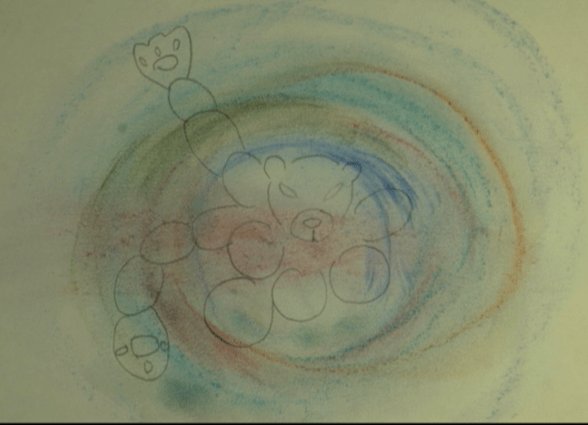

 Moving Image